




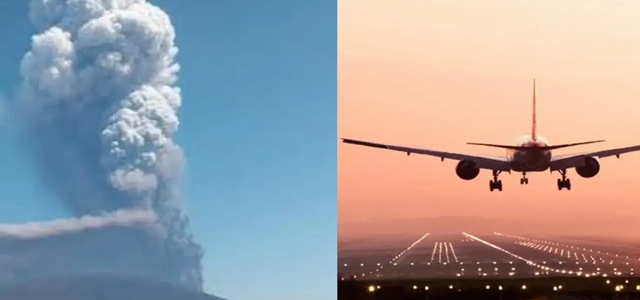
New Delhi, India — A long-dormant volcano in Ethiopia, Hayli Gubbi, has roared back to life after an estimated 10,000 to 12,000 years, spewing a massive ash cloud that has traveled thousands of kilometers, disrupting air traffic across the Middle East and South Asia, including India.
The explosive eruption, which began on Sunday morning in Ethiopia’s Afar region, propelled a thick column of ash and sulfur dioxide up to 14 kilometers (45,000 feet) into the atmosphere. The Toulouse Volcanic Ash Advisory Centre (VAAC) confirmed that the eruption has ceased, but a large, high-altitude plume has since drifted eastward, crossing the Red Sea towards Yemen and Oman before entering Indian airspace. The primary impact of the high-altitude ash cloud—traveling at speeds of 100-120 km/h—has been on the aviation sector. Volcanic ash poses a serious hazard to aircraft engines and can reduce visibility.
The Directorate General of Civil Aviation (DGCA) issued an operational advisory urging airlines to strictly avoid the designated ash-affected areas and adjust flight paths and fuel planning. Air India and Akasa Air cancelled and delayed several domestic and international flights, especially those flying to and from Middle Eastern destinations, as a precautionary measure. The plume entered western India via Gujarat and spread across states like Rajasthan, northwest Maharashtra, Delhi, Haryana, and Punjab.
Volcanic ash activity was reported over parts of the Arabian Peninsula, leading airlines, including SpiceJet, to issue cautionary notices for flights operating through the region. Flights between India and the UAE have faced cancellations and rerouting. The Oman Environment Authority warned of potential air quality impacts, though Saudi Arabia’s National Center for Meteorology stated the eruption posed no threat to its atmosphere.
Meteorological authorities in India have assured the public that the ash cloud’s effects remain largely confined to the upper troposphere, the altitude used by commercial air traffic. “The impact of this volcanic ash is being seen only in the upper troposphere, and it is affecting the flight operations. It has no impact on air quality and weather,” said Mrutyunjay Mohapatra, Director General of Meteorology at the India Meteorological Department (IMD). The IMD forecasts that the ash plume will move completely towards China and is expected to clear Indian airspace by Tuesday evening. While experts generally agree that the ash is too high to significantly worsen ground-level air quality—a concern for a city like Delhi, which is already battling ‘very poor’ air—residents in affected regions may notice the sky appearing darker and hazier than usual.
The sudden awakening of the Hayli Gubbi volcano, situated within the geologically active East African Rift System, has drawn wide scientific attention. The event highlights the immense power of tectonic forces in the Afar Depression, a region where two tectonic plates are slowly pulling apart. Authorities across the affected regions continue to monitor the plume’s movement closely, with airlines advising passengers to check their flight status before heading to the airport.