

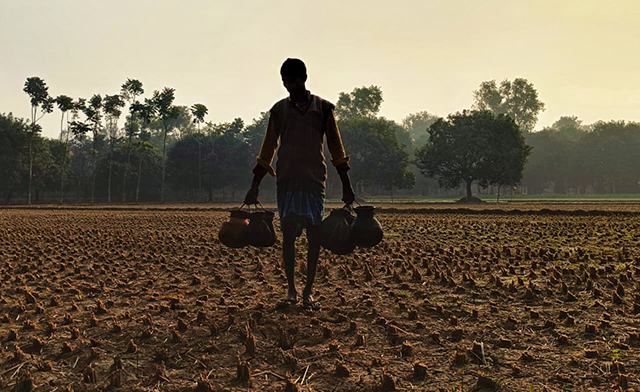
Rajarshi Ganguly, The Bengal News, 22nd Nov’2025, West Bengal: The collection of date palm sap is a skilled job, typically carried out during the winter months (roughly November to March) when the cooler temperature helps to prevent the sap from fermenting quickly.
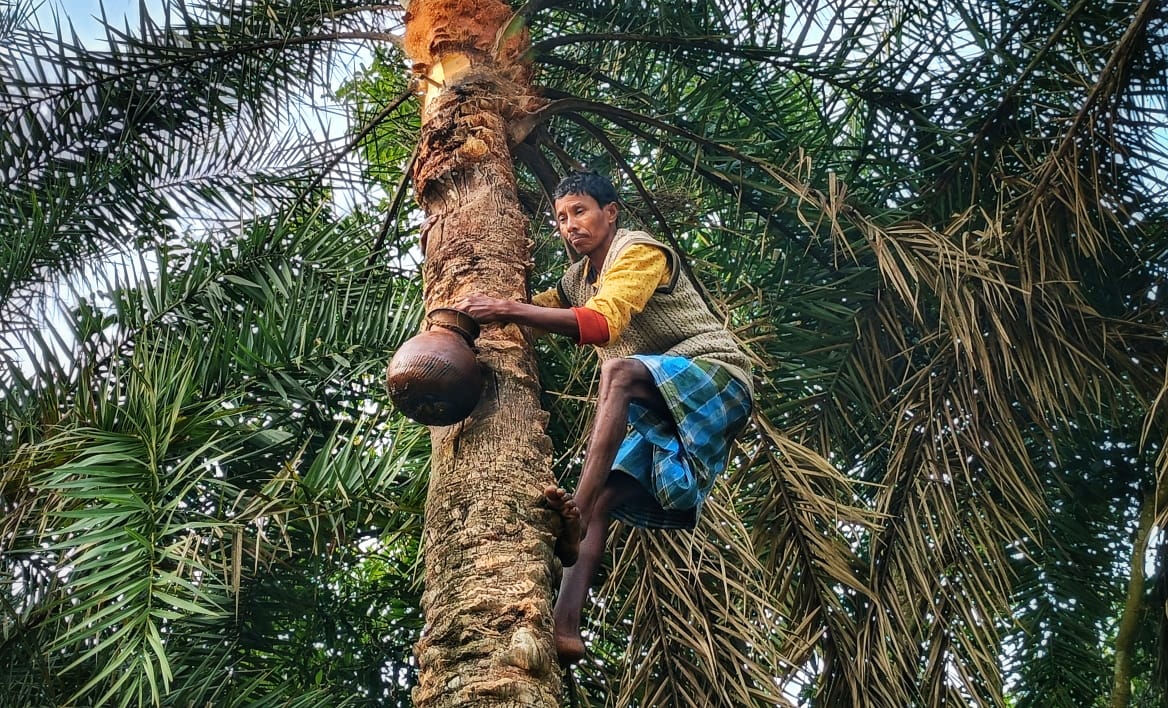 Date Plum Juice Collection / Photo : Rajarshi Ganguly
Preparing the Palm Tree (Tapping) : Expert villagers, known as tappers, first climb the date palm tree. They carefully remove the old and outer leaves near the crown to expose a portion of the tender stem or the growing point. This is a crucial step that requires great skill to ensure the tree survives for future harvests. A thin, precise, V-shaped or cone-shaped cut is made into the exposed inner layer of the stem. The quality and flow of the sap depend heavily on the skill of the tapper. A small, specially made bamboo or wooden tube, called a noli or spout, is inserted into the incision to direct the flow of the sap. An earthenware pot (var or handi) is securely hung beneath the spout. These pots are often smoked or treated with lime beforehand to keep them clean and delay the fermentation of the sweet sap.
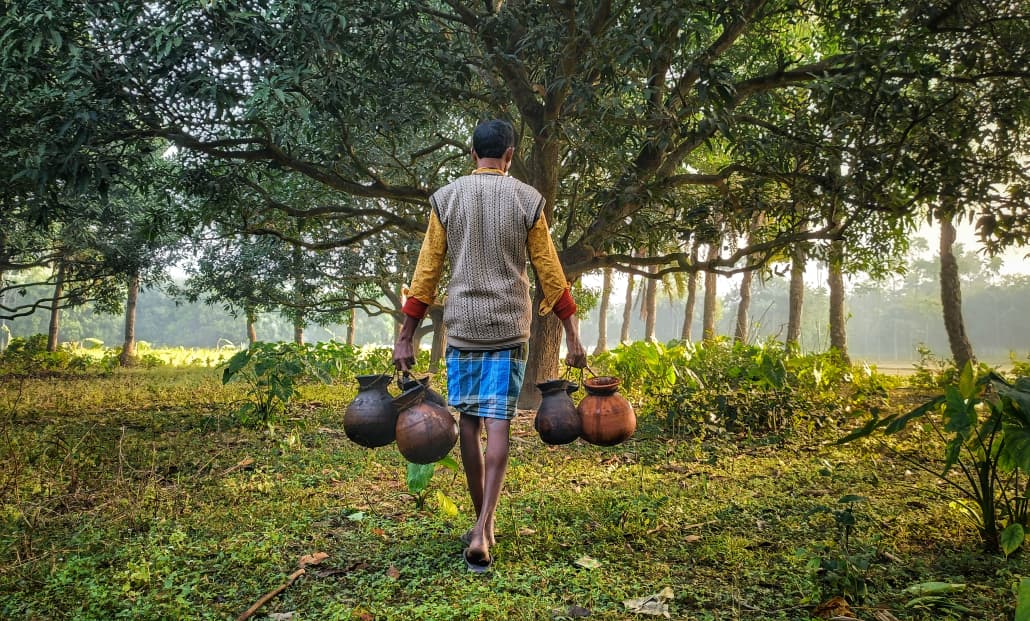 Date Plum Juice Collection / Photo : Rajarshi Ganguly
Collection Time : The process is typically done in the evening. The tapper climbs the tree, makes the fresh cut (or shaves a thin layer off the previous cut), and hangs the pot. The sap slowly drips into the pot overnight. The sap collected early in the morning, often before sunrise, is considered the sweetest and best quality (Jiren or Nolen), as the cool night temperatures slow down the fermentation process. The tapper returns in the early morning to retrieve the filled pots and sometimes makes a fresh cut to prepare the tree for the next collection. To ensure the tree’s survival, a rest period is usually given between tapping cycles.
The Process of Making Jaggery (Gur) :
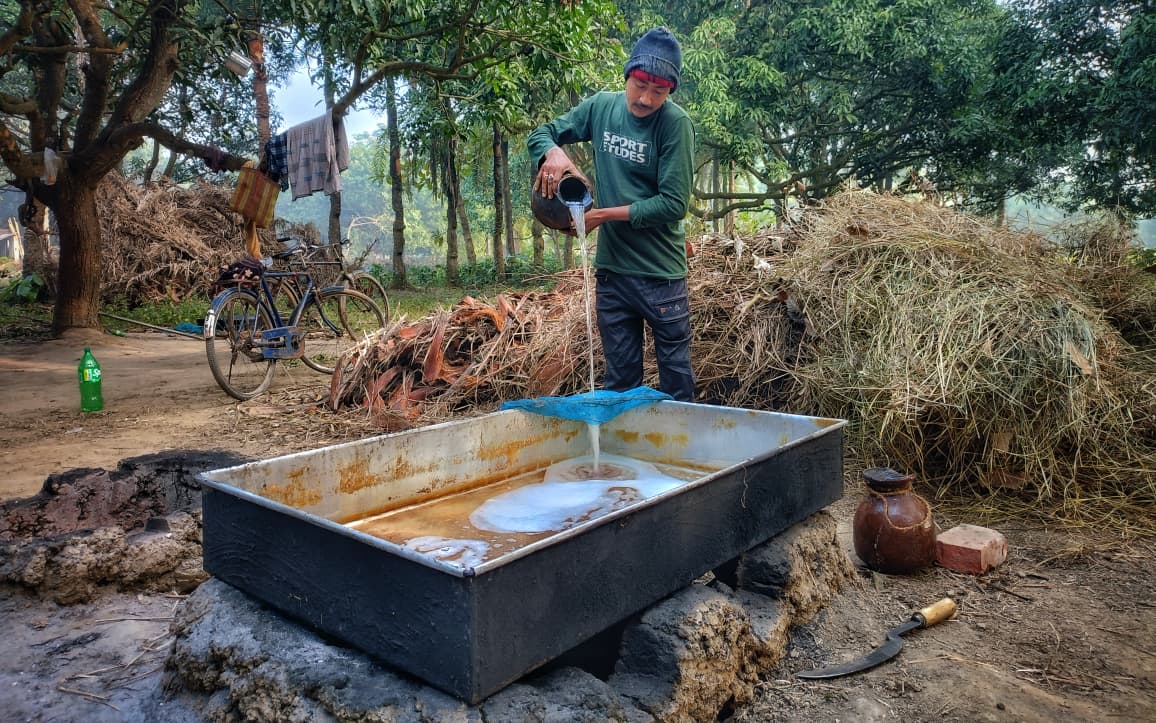 Process Of Jaggery / Photo : Rajarshi Ganguly
The collected sweet, clear sap is immediately taken to a processing area, often a temporary shed or open space in the village, to be boiled down into jaggery. The fresh sap is first filtered through a clean cloth to remove any debris, dust, or small insects that may have fallen into the pot during the night. The filtered sap is poured into large, shallow iron or tin pans (often called tawa) and placed over a traditional wood-fired mud oven (baan). The sap is heated vigorously. As it boils, a foamy layer is produced on the surface, which is continually skimmed off using a wooden ladle (orong) to ensure the final product is clean and clear. The continuous boiling causes the water to evaporate, and the sap thickens, turning from a clear liquid into a rich, golden-brown syrup. This stage requires constant stirring and monitoring by a skilled artisan to prevent it from sticking to the pan and burning.
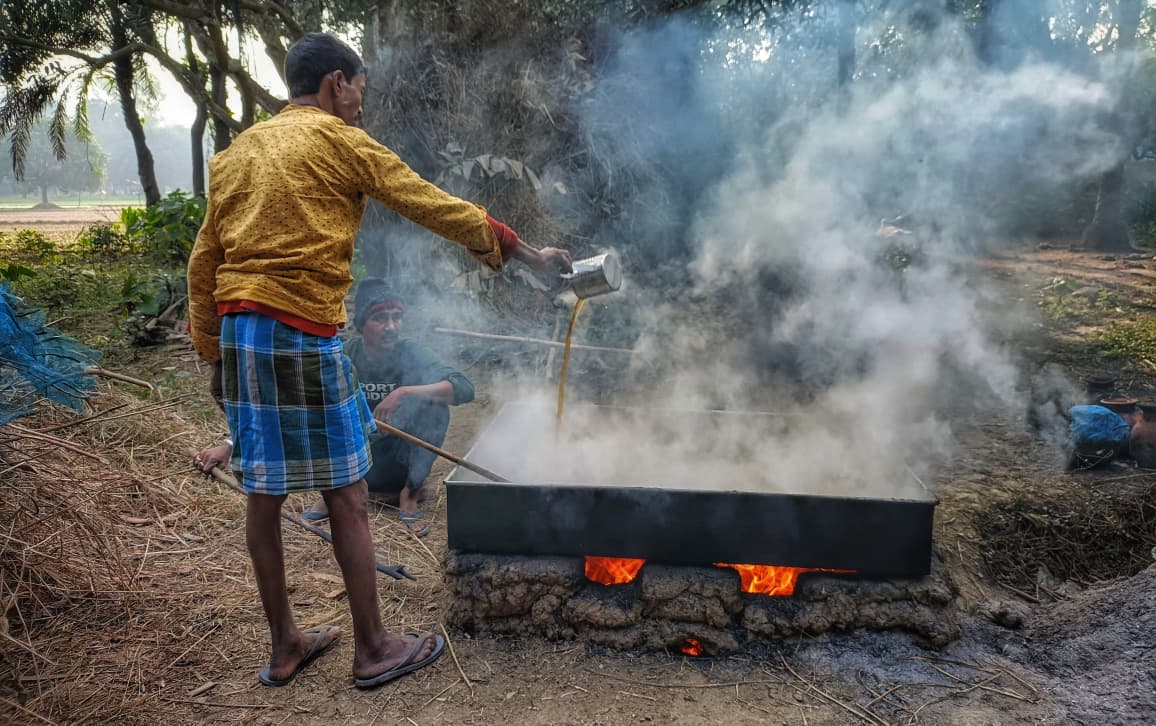 Process Of Jaggery / Photo : Rajarshi Ganguly
Jaggery Formation :
Liquid Jaggery (Jhola or Nolen Gur): If the boiling is stopped earlier, the result is a runny, highly fragrant liquid jaggery, a delicacy often associated with the first batches of the season.
Solid Jaggery (Patali Gur): To make solid jaggery, the boiling continues until the syrup reaches a high concentration (a specific brix value) and a thick, sticky consistency. The artisan checks the consistency by dripping a small amount into cold water to see if it sets properly.
Molding: Once the perfect consistency is reached, the thickened molasses is quickly poured into various molds. Traditionally, these molds are made of clay, earthenware, or even split coconut shells, which give the jaggery its characteristic shapes (like round Patali blocks or granulated Dana).
Cooling and Solidifying: The molds are left to cool down, during which time the jaggery hardens into its final, solid form.
The resulting date palm jaggery is known for its deep, caramel-like flavor with a distinct smoky undertone, which makes it a highly prized sweetener compared to sugarcane jaggery or refined sugar.